ALTERNATIVE DOCTOR, LLC



|
ALTERNATIVE DOCTOR, LLC
|
|
GRAPE SEED EXTRACT Grapes have been used by humans for thousands of years. They were around
during the Bronze age. The Greek poet, Homer, who lived about 700 BC, talked of
wine made from grapes. The fruit is mentioned in the Bible, and Egyptian tombs
and relics have representations of grapes on them. People have used grapes for purposes other than eating or making into wine or
juice. European folk healers, hundreds of years ago, made an ointment from the
sap in the stems to cure skin and eye diseases. Leaves were astringent and
hemostatic, that is, they were used to stop bleeding, inflammation, and pain,
such as the kind brought on by hemorrhoids. Unripe grapes treated sore throats;
dried grapes, or raisins, treated consumption, constipation, and thirst. The
round, ripe, sweet grapes, however, had the most uses of all, used to treat
cancer, cholera, smallpox, nausea, eye infections, and skin, kidney, and liver
diseases. Plant Description Grapes are native to Asia near the Caspian Sea, but were brought to North
America and Europe: European settlers brought grapes to North America in the
1600s. This plant's climbing vine has large, jagged leaves, and its stem bark
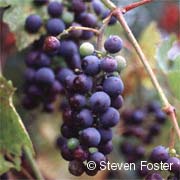
tends to peel. The grapes themselves may be green, red, or purple. What's It Made Of? Today we eat grapes or raisins because we like them, and we drink wine and
grape juice for the same reason. But in 1970, a biochemist in France isolated
from grape seed a material that improves blood circulation—oligomeric
proanthocyandin (OPC). It also reduces swelling, and may even prevent heart
disease. OPC is one of the substances in red grape juice and red wine that has
been shown to have some protective properties against heart disease. Because of
its OPCs, grapes are now harvested not only for the food and drink products we
are familiar with, but also as a source of these therapeutically active
ingredients. First and foremost, OPCs are antioxidants, which help the body to handle
assaults that could eventually cause disease, such as cigarette smoke and
environmental chemicals. They are different from a broader category of stress
protectors called adaptogens, which also protect you from chemical or physical
substances. Antioxidants or adaptogens also protect you from physical and mental
exhaustion and help you recover after an illness. Both antioxidants and
adaptogens may help us avoid at least two of the big killers today:
cardiovascular disease and cancer. OPC's antioxidant actions may help prevent cardiovascular disease. Some
studies suggest that it might reduce the formation of plaques in the arteries,
and may help regenerate damaged tissue lining the arteries. If you have a family
history of cardiovascular disease, you may want to look into taking OPCs.
Chronic venous insufficiency is another reason to take OPCs, as is vision
disturbance from diabetic nephropathy or macular degeneration, for example.
These uses of OPC have been supported in clinical studies. Future uses may include the treatment of premenstrual syndrome (PMS), and to
stop swelling in the face after plastic surgery. OPC has helped reduce the
breast discomfort and aching joints and legs that sometimes occur with PMS, and
has decreased recovery time from plastic surgery. Antitumor actions have also
been shown. Available Forms Grape seed extracts are available in fluid extract form or in capsules and
tablets. Look for products that are standardized to 95 percent OPC content. How to Take It Results from clinical trials suggest that grape seed OPCs may help vision
difficulty as well as chronic venous insufficiency and its symptoms. Lymphedema,
varicose veins, cancer, premenstrual syndrome, dental caries, and circulatory
disorders are some of the many other types of conditions that OPC treatment
might help with. As a preventative for arterial plaques, vision disorders, or other
conditions, take 50 mg standardized extract per day. For specific illness, 150
to 300 mg per day is recommended, but consult your health care provider and
don't self-prescribe. Precautions There are currently no precautions for grape seed OPC use. It is considered
very safe. Possible Interactions Grape seed extract may enhance the effects of anti-inflammatory medications
and cholesterol-lowering medications. Therefore, consult with your health care
professional before taking grape seed extract along with such medications. There have been reports of a possible decrease in the effectiveness of
antibiotics, specifically tetracycline and tetracycline-derivatives like
doxycycline. If you are currently taking any of these antibiotics, you should
not use this herb. Supporting Research Amsellem M, et al. Endotelon in the treatment of venolymphatic problems in
premenstrual syndrome: multi-center study on 165 patients. Tempo Medical.
1987;282. Ariga TK, Hamano M. Radical scavenging action and its mode in procyanidins
B-1 and B-3 from azuki beans to peroxyl radicals. Agricultural Biological
Chemistry. 1990;54:2499–2504. Baruch J. Effect of grape seed extract in postoperative edema [in French].
Ann Chir Plast Esthet. 1984;4. Blumenthal M, Riggins C. Popular Herbs in the U.S. Market: Therapeutic
Monographs. Austin, Tex: American Botanical Council; 1997. Bombardelli E, Morazzoni P. Vitis vinifera L. Fitoterapia. 1995;
66:291–317. Chang WC, Hsu FL. Inhibition of platelet aggregation and arachidonate
metabolism in platelets by procyanidins. Prostagland Leukotri Essential Fatty
Acids. 1989;38:181–188. Corbe C, Boissin JP, Siou A. Light vision and chorioretinal circulation:
study of the effect of procyanidolic oligomers (Endotelon) [in French]. J Fr
Ophthalmol. 1988;11:453–460. Delacrois P. Double-blind study of grape seed extract in chronic venous
insufficiency. La Revue De Med. 1981;28–31. Fromantin M. Les oligomeres procyanidoliques dans le traitement de la
fragilite capillaire et de la retinopathie chez les diabetiques: a propos de 26
cas. Med Int. 1982;16. Kashiwada Y, et al. Antitumor agents, 129: tannins and related compounds as
selective cytotoxic agents. J Nat Prod. 1992;55:1033–1043. Lagrua G, et al. A study of the effects of procyanidol oligomers on capillary
resistance in hypertension and in certain nephropathis. Sem Hop.
1981;57:1399–1401. Maffei FR, Carini M, Aldini G, Bombardelli E, Morazzoni P, Morelli R. Free
radical scavenging action and anti-enzyme activities of procyanidins from
Vitis vinifera: a mechanism for their capillary protective action.
Arzneimittelfarichung. May 1994; 44:592–601. Maffei FR, Carini M, Aldini G, Bombardelli E, Morazzoni P. Sparing effect of
procyanidins from Vitis vinifera on vitamin E: in vitro studies.
Planta Med. 1998;64:343–347. Masquelier J. Comparative action of various vitamin P related factors on the
oxidation of ascorbic acid by cupric ions. Bulletin de la Societe de Chimie
Biologique. 1951;33:304–305. Masquelier J. Natural products as medicinal agents. Planta Med.
1980;242S–256S. Meunier, M.T., et al. Inhibition of angiotensin I converting enzyme by
flavonolic compounds: in vitro and in vivo studies. Planta Med.
1987;53: 12–15. Murray M. The Healing Power of Herbs: the Enlightened Person's Guide to
the Wonders of Medicinal Plants. Rocklin, Calif: Prima Publishing; 1995. Ruf JC, Berger JL, Renaud S. Platelet rebound effect of alcohol withdrawal
and wine drinking in rats. Relation to tannins and lipid peroxidation.
Arterioscler Thromb Vasc Biol. 1995;15(1):140–144. Schultz V, Hänsel R, Tyler V. Rational Phytotherapy: A Physician's Guide
to Herbal Medicine. New York, NY: Springer-Verlag; 1998. Schwitters B, Masquelier J. OPC in Practice: The Hidden Story of
Proanthocyanidins, Nature's Most Powerful and Patented Antioxidant. Rome,
Italy: Alfa Omega Publishers; 1995. Takahashi T, Kamiya T, Hasegawa A. Procyanidin oligomers selectively and
intensively promote proliferation of mouse hair epithelial cells in vitro and
activate hair follicle growth in vivo. J Invest Dermatol.
1999;112(3):310–316. Takahashi T, Kamiya T, Yokoo Y. Proanthocyanidins from grape seeds promote
proliferation of mouse hair follicle cells in vitro and convert hair cycle in
vivo. Acta Derm Venereol. 1998;78(6):428–432. Tebib, K, et al. Dietary grape seed tannins affect lipoproteins, lipoprotein
lipases, and tissue lipids in rats fed hypercholesterolemic diets. J Nutr.
1994; 124: 2451–2457. Tebib K, et al. Polymeric grape seed tannins prevent plasma cholesterol
changes in high-cholesterol-fed rats. Food Chem. 1994;49:403–406. Walker, Morton. The nutritional therapeutics of Masquelier's oligomeric
proanthocyanidins (OPCs). Townsend Letter for Doctors and Patients.
1996;175/76: 84–92. Yamakoshi J, Kataoka S, Koga T. Proanthocyanidin-rich extract from grape
seeds attenuates the development of aortic atherosclerosis in cholesterol-fed
rabbits. Atherosclerosis. 1999;142(1):139–149. Zafirov D, Bredy-Dobreva G, Litchev V, Papasova M. Antiexudative and
capillaritonic effects of procyanidines isolated from grape seeds (V.
vinifera). Acta Physiol Pharmacol Bulg. 1990;16:50–54. Copyright © 2000 Integrative Medicine Communications The publisher does not accept any responsibility for the
accuracy of the information or the consequences arising from the application,
use, or misuse of any of the information contained herein, including any injury
and/or damage to any person or property as a matter of product liability,
negligence, or otherwise. No warranty, expressed or implied, is made in regard
to the contents of this material. No claims or endorsements are made for any
drugs or compounds currently marketed or in investigative use. This material is
not intended as a guide to self-medication. The reader is advised to discuss the
information provided here with a doctor, pharmacist, nurse, or other authorized
healthcare practitioner and to check product information (including package
inserts) regarding dosage, precautions, warnings, interactions, and
contraindications before administering any drug, herb, or supplement discussed
herein. |