

by admin
Echinacea
November 4, 2010 in Herbal Medicine by admin
Echinacea - Herbal Medicine
In the 1980s, experiments with echinacea demonstrated that it still had possible therapeutic applications. Today, some people note that echinacea reduces the amount of time it takes for a cold or flu to run its course. It is also used for nasal, sinus, and bronchial illnesses, and echinacea ointments can speed the healing of wounds that are slow to heal.
Plant Description of Echinacea
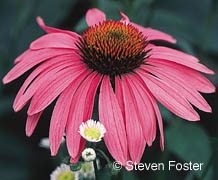
Echinacea has tall stems and bears single flowers that look similar to black-eyed Susans, except that echinacea flowers are pink or purple, and the cone in the middle is usually a purplish brown. The cone (the “eye” in black-eyed Susan) is actually a seed head and is very large on echinacea flowers. It has sharp spines that look like a stiff comb or an angry hedgehog. This is actually where echinacea got its name: echinos is Greek for hedgehog. Of nine species, three are used medicinally, which vary in appearance from the intensity of petal color to the stiff or drooping way the petals encircle the seed head.
What’s Echinacea Made Of?
Many plant chemicals are involved in echinacea’s effects: polysaccharides, flavonoids, caffeic acid derivatives, essential oils, polyacetylenes, alkylamides, and alkaloids. Polysaccharides are known to trigger cells in the body that fight infection.
Available Products and Forms of Echinacea
Extracts, tinctures, tablets, capsules, ointments, and stabilized fresh extracts are available.
How to Take Echinacea
Echinacea’s immune stimulant actions reduce inflammation and help the body fight bacteria and viruses. Tests show that echinacea stimulates immune system cells into action. When these cells are activated, white blood cells are more ready to wrap themselves around illness-causing invaders and to move viruses or bacteria out of your system, prevent them from reproducing themselves, or simply stop their activity.
While many individuals choose to take echinacea on a daily basis during the winter to help prevent colds and flu, studies have not consistently shown that this type of use is effective. On the other hand, echinacea can reduce the length of time that you have a cold or the flu. And, if you have rheumatoid arthritis and have trouble with steroid-based anti-inflammatory drugs, echinacea may provide you with very mild relief and no side effects.
For general immune system stimulation, during colds, flu, upper respiratory tract infection, or bladder infection, choose from the following forms of Echinacea and take three times a day.
- 1 to 2 g dried root, as tea
- 2 to 3 ml of 22 percent ethanol extract standardized to contain 2.4 percent beta-1,2-fructofuranosides
- 200 mg of powdered extract containing 6.5:1, or 3.5 percent, echinacoside
- Fluid extract (1:1): .5 ml to 1 ml
- Tincture (1:5): 1 to 3 ml
- Stabilized fresh extract: .75 ml
For arthritis, take 15 drops daily of a standardized Echinacea extract produced by a reputable manufacturer.
For slow-healing wounds, apply Echinacea creams or ointments as desired.
Precautions for Echinacea
The American Herbal Products Association gives echinacea a class 1 safety rating, so it’s safe as long as you use it as recommended by your health care provider or as instructed on the product label. In Germany, continual use of echinacea is restricted to eight weeks. Discuss long-term use with your health care provider.
Echinacea is a member of the Compositae family and as such may rarely cause an allergic reaction.
When you take echinacea orally, you will notice a strong numbing and tingling sensation on your tongue. This is normal and goes away quickly.
Some cases of skin rash and itching have been reported, but these are rare. Do not use echinacea if you have tuberculosis, leukoses, diabetes, collagenosis, multiple sclerosis, AIDS, HIV infection, or an autoimmune disease. If you are pregnant, consult with your health care provider before taking echinacea.
Possible Interactions with Echinacea
Because echinacea can affect your immune system, do not take this herb if you are on any immunosuppressive therapies.
Supporting Research on Echinacea
Berman S. Dramatic increase in immune-mediated HIV killing activity induced by Echinacea angustifolia. Int Conf AIDS 12 (582). Abstract 32309.
Blumenthal M, ed. The Complete German Commission E Monographs: Therapeutic Guide to Herbal Medicine. Boston, Mass: Integrative Medicine Communications; 1998.
Bräunig B, Dorn M, Knick E. Echinacea purpurea radix for strengthening the immune response in flu-like infections. Z Phytotherapie. 1992;13:7–13.
Dorn M, Knick E, Lewith G. Placebo-controlled, double-blind study of Echinacea pallidaeradix in upper respiratory tract infections. Complementary Therapies in Medicine. 1997;5:40–42.
Hobbs C. Echinacea: a literature review. Herbalgram 1994;30:33–47.
Hobbs C. The Echinacea Handbook. Sandy, Ore: Eclectic Medical; 1989. Coeugniet E, Kuhnast R. Adjuvant immunotherapy with different formulations of echinacin [in German]. Therapiwoche. 1986;36:3352–3358.
Hoheisel O, Sandberg M, Bertram S, Bulitta M, Schäfer M. Echinagard treatment shortens the course of the common cold: a double-blind, placebo-controlled clinical trial. European Journal of Clinical Research. 1997;9:261–269.
Hyman R, Pankhurst R. Plants and Their Names: A Concise Dictionary. New York, NY: Oxford University Press; 1995.
Mattocks AR. Chemistry and Toxicology of Pyrrolytic Alkaloids. New York, NY: Academic Press; 1986:chap 12.
McGuffin M, Hobbs C, Upton R, Goldberg A, eds. American Herbal Products Association’s Botanical Safety Handbook. Boca Raton, Fla: CRC Press; 1996.
Melchart D, Walther E, Linde K, Brandmaier R, Lersch C. Echinacea root extracts for the prevention of upper respiratory tract infections: a double-blind, placebo-controlled randomized trial. Arch Fam Med. 1998;7:541–545.
Melchart D, Linde IK, Worku F, Sarkady L, Holzmann M, Jurcic K, et al. Results of Five Randomized Studies on the Immunomodulatory Activity of Preparations of Echinacea. J Alt Comp Med. 1995;1(2):145–160.
Miller LG. Herbal medicinals: selected clinical considerations focusing on known or potential drug-herb interactions. Arch Intern Med. 1998;158(20):2200–2211.
Murray MT. The Healing Power of Herbs: The Enlightened Person’s Guide to the Wonders of Medicinal Plants. Rocklin, Calif: Prima Publishing; 1995.
Newall CA, Anderson LA, Phillipson JD. Herbal Medicines: A Guide for Health-Care Professionals. London: The Pharmaceutical Press; 1996.
Schulz V, Hänsel R, Tyler VE. Rational Phytotherapy: A Physicians’ Guide to Herbal Medicine. 3rd ed. Berlin: Springer; 1998.
Snow JM. Echinacea. Protocol J Botanical Medicine. 1997;2:18–24.
Thompson KD. Antiviral activity of Viracea against acyclovir susceptible and acyclovir resistant strains of herpes simplex virus. Antiviral Res. 1998;39:55–61.
Tyler VE. Herbs of Choice: The Therapeutic Use of Phytomedicinals. Binghamton, NY: Pharmaceutical Products Press; 1994.
Verhoef MJ, Hagen N, Pelletier G, Forsyth P. Alternative therapy use in neurologic disease: use in brain tumor patients. Neurology 1999;52:617–622.
Copyright © Integrative Medicine Communications
